


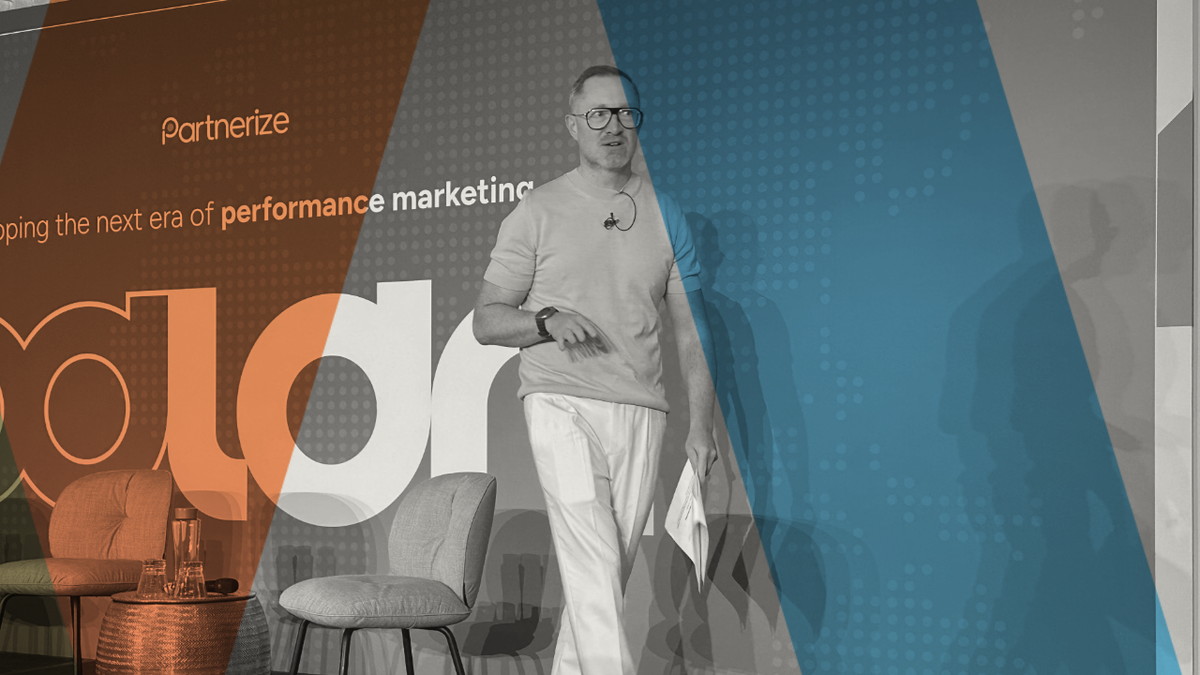
Despite the rapid changes unfolding in the digital space, affiliate “will continue to be important within this new paradigm.”
These words from Eliott Lee, Director of Partnerships at Profound, set the tone for the day: there are no doubt challenges ahead — from margin pressure and monetisation hurdles to tracking and attribution headaches — but this is tempered with opportunity.
Indeed, the day illustrated that the next era of the industry will be defined by how affiliate and performance marketing adapts and responds, the tools that are built and how they’re utilised.
The machine-mediated market
The keynote panel delved into this and the shift to the machine-mediated market, which has created a need for a new economic model to both verify and compensate influence.
The session looked into the role governance and measurement standards and cross-industry initiatives play in shaping this next phase of the industry and how closed-loop systems can help bridge the gap between upstream AI influence and downstream commercial value and outcomes.
Alongside this, new roles are being created to meet the realities of this new era, the panellists shared, including marketing engineers — a hybrid role that acts as an orchestrator of AI tools and sits at the “epicentre” of an organisation.
A gold standard
Later in the day, panellists explored what happens when influence becomes invisible.
Here, the conversation interrogated the limitations of click-based attribution — something which panellists agreed no longer acts as a complete indicator of consumer value.
Aneira Henery, Global Head of Partnerships and Growth at loveholidays, said that through utilising tools like VantagePoint, her team was able to surface that for every one last tracked conversion, 43 go untracked.
Meanwhile, Louis Jenkins, Managing Director at Acquire, shared that his team had witnessed up to 65% of customer purchases not being attributed, and The Independent’s Ed Hutchinson noted that while 78% of the publisher’s audience seeks shopping inspiration through the site, the publication receives commissions on only 70 to 80% of journeys they influence — a figure that drops to 50% for travel.
One panellist advocated for hybrid compensation models as a “gold standard” for affiliate marketers, to foster credible relationships, rather than incentivising last-click transactions.
The human element
Another theme that dominated throughout the day was the importance of the human touch in an increasingly AI-dominated world, with Expedia’s Michael Long bringing in the acronym of HMH: Human, Machine, Human. This was echoed in another panel by Acceleration Partners’ Ben Norton, who said that while AI is a powerful tool for large data sets and management optimisation, the human voice is still essential and even more valuable.
And as AI rewrites the rulebook, the focus on full funnel is increasingly coming into view, with the shift in approach a common thread through the day.
Shireen Patel, Digital Marketing Manager at Liberty London, noted that too many programmes have 90% of their conversions “trapped in the bottom of the funnel,” spending the majority of their budget there.
Indeed, the panellist noted that while conversion-driving models, like cash back loyalty, are resilient in the current economic climate, according to one panellist, this is only a secure avenue for short-term growth, as resilience derives from receiving new customers, and that’s a pool that can run dry quickly. And brands are increasingly less willing to invest here.
Stay tuned for exclusive interviews from Partnership Day.
