


AI has made content creation faster and cheaper than at any point in marketing history. The AI content marketing industry has grown, as nearly 94% of marketers now say they plan to use AI somewhere in their content process. Yet speed has not solved the older problem of being remembered.
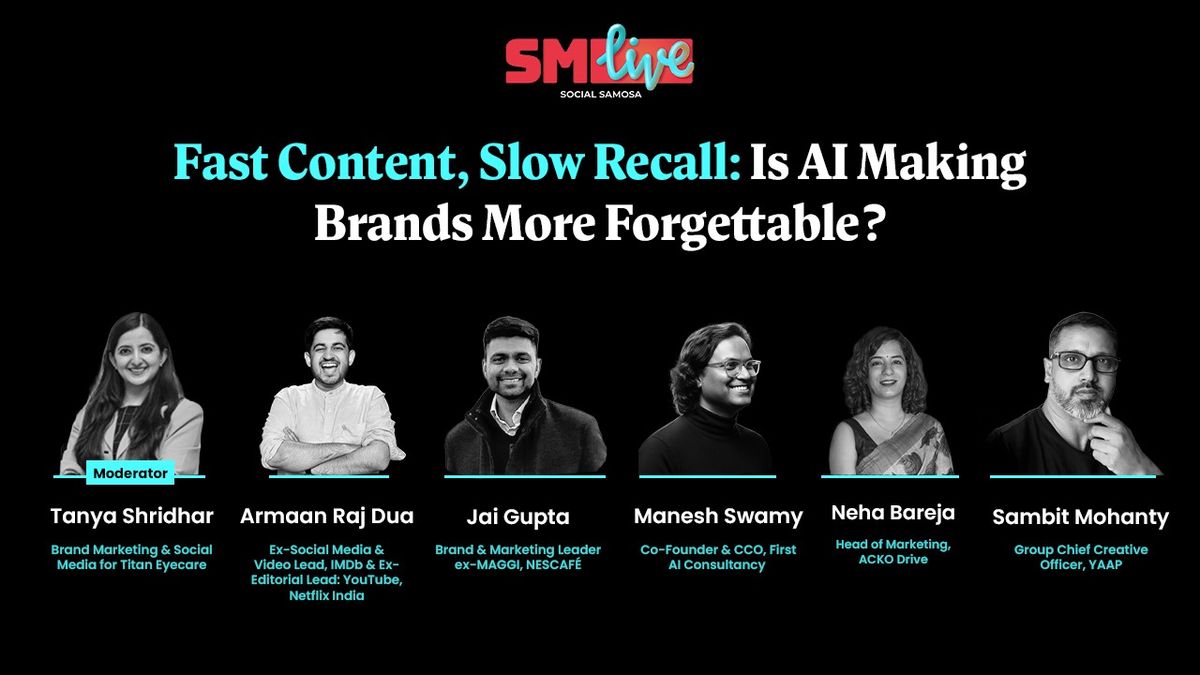
At SM Live’s panel titled ‘Fast Content, Slow Recall: Is AI Making Brands More Forgettable,’ leaders debated whether the very tools built to help brands scale are quietly making them interchangeable.
The panel included Manesh Swamy, Co-Founder & CCO, First AI Consultancy; Neha Bareja, Head of Marketing, ACKO; Armaan Raj Dua, Ex-Social Media & Video Lead, IMDb; Sambit Mohanty, Group Chief Creative Officer, YAAP; Jai Gupta, Brand & Marketing Leader, ex-MAGGI, NESCAFÉ.
Moderator Tanya Shridhar, Brand Marketing & Social Media for Titan Eyecare, opened by asking what makes a brand memorable, as every competitor can move at the same speed.
Jai Gupta argued that the fundamentals have not shifted even if the tools have. He said the questions that built brands in the 1920s, namely a brand’s point of view, its purpose and the consumer problem it solves, remain the starting point today.
In his words, “AI can help you in stress testing that idea, but it doesn’t build it for you.” He added that judgment still has to come before the tool is switched on, and that the discipline of writing and rewriting a brief, once a weeks-long exercise, can now happen in a matter of hours without losing its rigour. As he put it, “that rigour still keeps, and that is what differentiates a great brand versus just jumping on the bandwagon.”
Why distribution is no longer the differentiator
Armaan Raj Dua broke AI’s role into three separate functions: discovery, creation and filtering, cautioning that the conversation often collapses these into one.
“Around 70% to 80% of purchasing happens before anyone actually interacts with any brand content,” he said, pointing to channels like WhatsApp, Reddit communities and AI tools as where that early decision-making now happens. He also noted that platforms are beginning to actively reward originality. Google’s framework for evaluating expertise, experience, authoritativeness, and trust now shapes what content surfaces. Dua predicted that within a year, the industry conversation will move past how much AI a brand uses and focus instead on whether it was used correctly for the right task.
As he summarised it, “we’re not going to be talking so much about which brand used more AI, which brand used less AI.”
This view found support from Neha Bareja. She said distinctiveness still begins with understanding the consumer’s problem at a granular level, using the example of how Acko reframed insurance, a category long built on fear, through culturally specific storytelling involving Bollywood references rather than generic warnings.
She noted that production cost used to act as a filter that kept weaker ideas out of the market, but that barrier has now disappeared because production has become a level playing field. “The uniqueness of the idea and the way you tell it is still going to build that memory structure and memorability over a longer period of time,” she said.
Sambit Mohanty pushed the conversation toward what should never be delegated to AI. He described a growing temptation in the industry to let the tool replace the thinking itself, warning that AI computes but does not imagine. “Let’s not forget that AI ultimately is a tool which is available to everybody,” he said, arguing that brands need to use it rather than let it use them.
As a cautionary example, he referenced a Starbucks Korea campaign from May 2026, where an AI-generated promotional asset triggered public backlash because the creative team was unaware of the historical weight attached to the imagery used, a misstep that hurt the brand’s standing in the market.
He said, “Once you have a machine think for you and write for you, you are really cooked as a species.”
For Mohanty, the antidote is treating AI strictly as a craft tool while keeping imagination and cultural judgment with people.
Where the line actually sits for consumers
Manesh Swamy offered the operational counterpoint, arguing that execution, not strategy, is where AI delivers the clearest value. He described building tools that adapt a single piece of broadcast content, such as a celebrity-led television commercial, into culturally resonant versions for different Indian language markets within minutes, work that previously required entirely separate productions.
“AI or the group of AI agents is your best friend who’s a big production expert,” he said. He added that the goal internally is for output to look like “invisible AI,” indistinguishable from work made with a full production team, rather than something that announces its own AI origin.
When the panel shifted to the consumer’s perspective, the group converged on a clear boundary. Bareja said her biggest discomfort as a consumer comes when AI-generated personas are used to sell health or wellness products, since that removes any lived experience behind the claim. “If it’s a protein powder, or if it’s a skin product, and there’s an AI model saying it, that, for me, is a very big red flag,” she said.
Dua extended this into a broader framework, arguing that AI is well accepted for high utility, low personal stakes content such as news summaries or tutorials, but trust drops sharply for categories like financial or medical advice, where consumers expect a human behind the judgment.
Dua closed with what he called three constants in brand building that AI cannot replicate on its own: surprise, the ability to say something genuinely new in a category; specificity, the nuance required to speak to India’s fragmented and culturally distinct markets; and participation, the kind of organic third-party mention that builds trust at scale.
“The brands that have been bad at brand building are going to continue being bad at brand building, just with better tools,” he said. He noted that brands earning more organic mentions are also gaining outsized visibility inside AI search results themselves, since brand web mentions correlate strongly with AI Overview visibility, with the top quartile earning up to 10 times more mentions than the next tier. His conclusion, echoed across the panel, was that AI does not level the playing field between strong and weak brand builders. It simply gives both groups faster tools to be exactly what they already were.
